
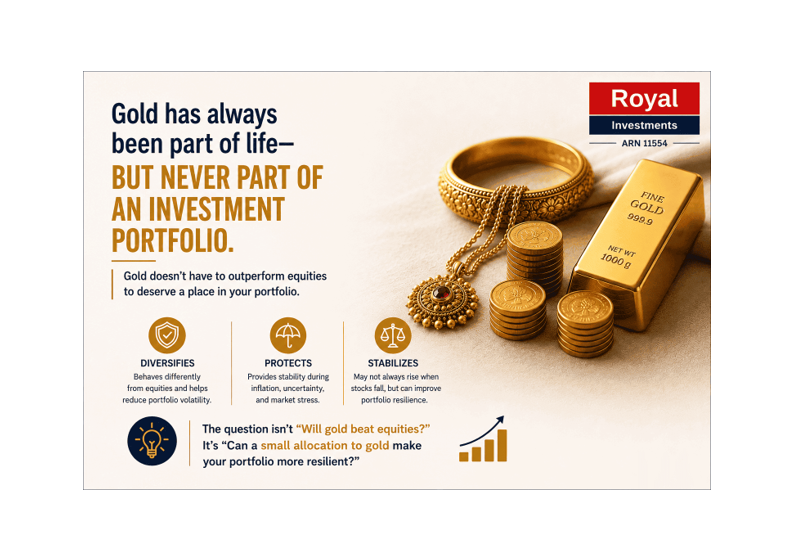
Gold has long been part of Indian households—but not always part of investment portfolios.
For many Indians, gold is associated with weddings, festivals, and family traditions. It is often purchased as jewellery, carrying emotional and cultural significance rather than being viewed as a financial asset.
However, a comparison of different portfolio allocations highlights an interesti interesting insight:
Gold doesn’t have to outperform equities to deserve a place in a portfolio.
One of the fundamental principles of investing is that success isn’t about owning the best-performing asset every year. It’s about building a portfolio where different asset classes complement one another.
Many investors primarily allocate their savings to mutual funds, Indian equities, PPF, and other India-focused investments. While these are excellent long-term wealth creators, they also mean that a significant portion of wealth is tied to the performance of the Indian economy.
Gold behaves differently.
Historically, it has often acted as a diversifier during periods of inflation, economic uncertainty, geopolitical tensions, and market volatility. While it may not always rise when equities fall, its relatively different behaviour has helped reduce the overall volatility of diversified portfolios.
Another important distinction is often overlooked:
Owning jewellery is not the same as investing in gold.
Jewellery carries making charges, GST, emotional value, and resale inefficiencies. Investment gold—through instruments such as Gold ETFs or Gold Mutual Funds—serves an entirely different purpose: portfolio diversification.
The conversation, therefore, should perhaps shift from asking:
“Will gold outperform equities?”
to asking:
“Can a modest allocation to gold make a portfolio more resilient across different market cycles?”
Sometimes, the objective isn’t to maximize returns from a single asset class. It’s to build a portfolio that can withstand uncertainty while delivering sustainable long-term growth.
How do you view gold—as a traditional store of value, a portfolio diversifier, or both?
Disclaimer- 1) Mutual Fund investments are subject to market risks. Read all scheme related documents carefully.